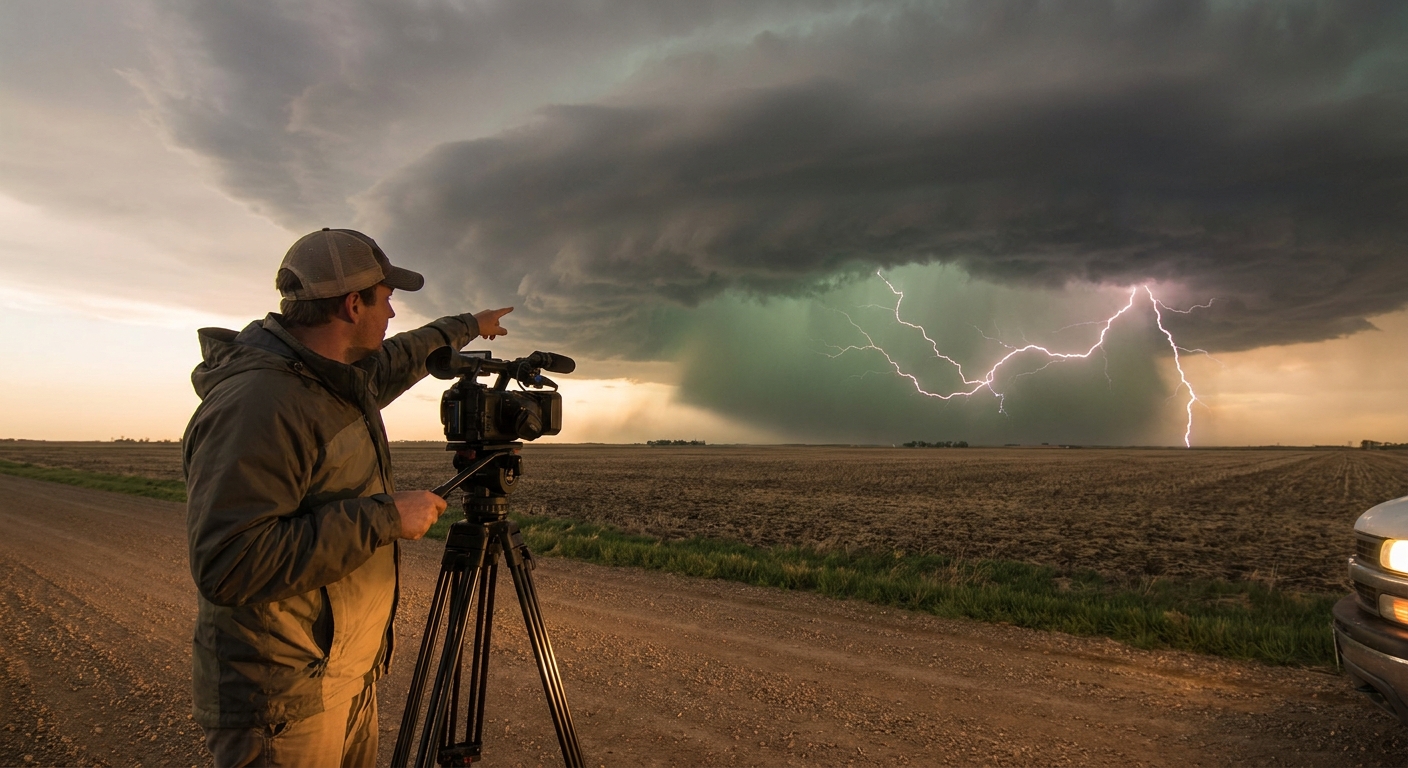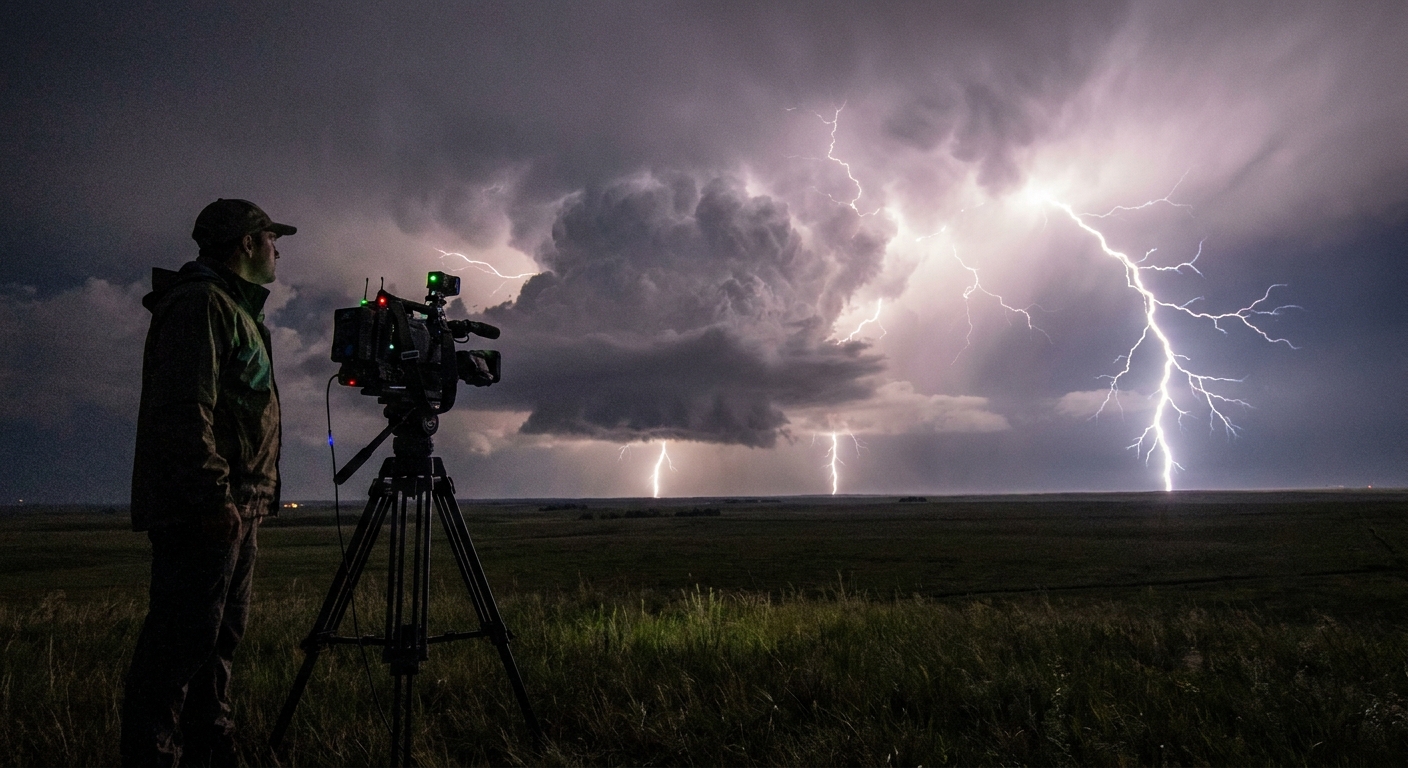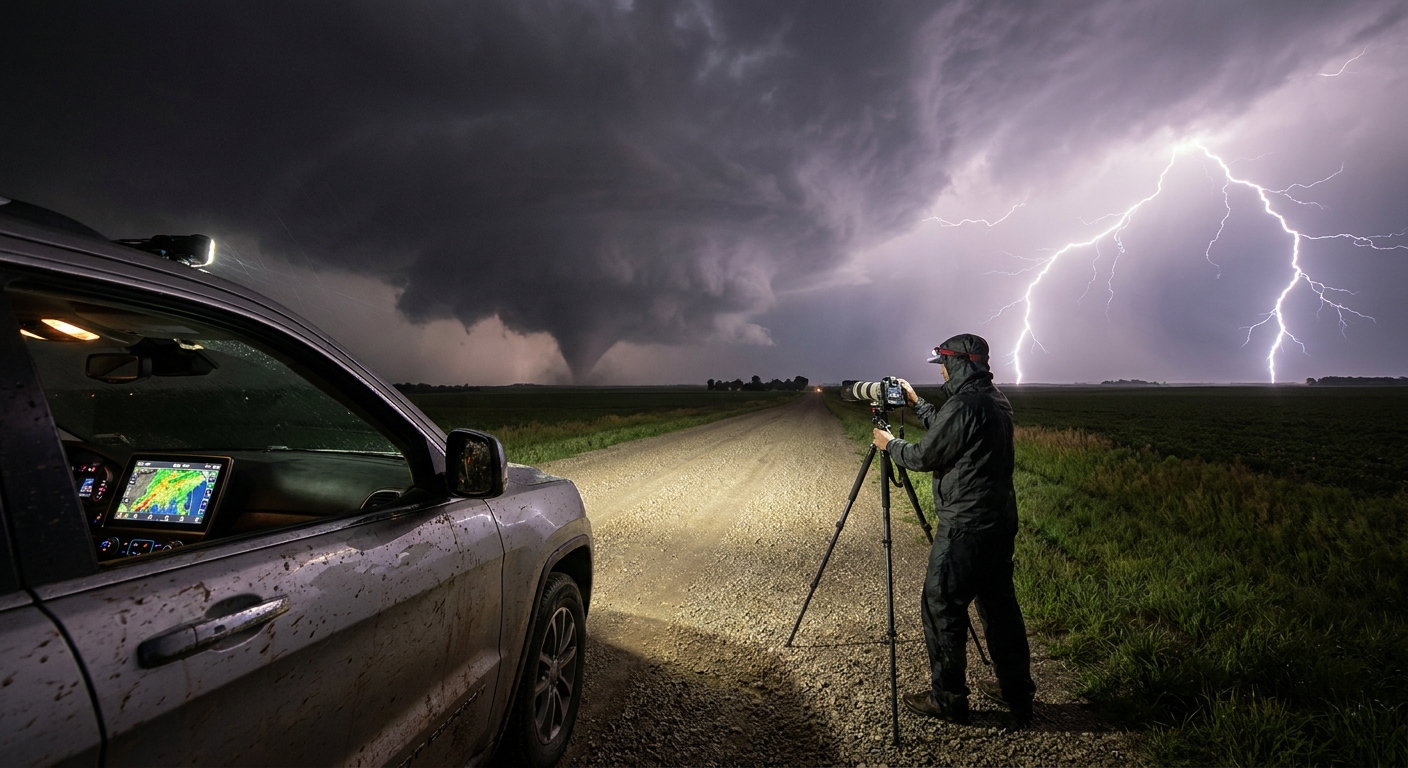
Ask ten chasers what they’re out there for and most will answer in one word: tornadoes. But if you chase long enough, lightning starts stealing the show.
Two Obsessions, One Storm
Some setups are marginal for tornadic potential but absolutely prime for electricity. When voltage becomes the main prize, your strategy, positioning, and risk calculus all shift.
This is a side-by-side comparison of tornado-centric vs. lightning-centric chasing — how the goals differ, where the tactics diverge, and what that means for your safety and your footage.
Forecast Mindset: Rotating Columns vs. Electric Factories
Tornado-Focused
You’re hunting for:
- Surface-based instability with rich moisture
- Strong, veering wind profiles (large low-level shear)
- Discrete supercells along focused boundaries
Key tools:
- Low-level hodographs
- Surface obs and boundaries
- STP/SCP, LCL heights, CIN evolution
The storm’s low levels are the main event.
Lightning-Focused
You’re hunting for:
- Deep convection with strong updrafts
- High CAPE, especially through the mixed-phase region
- Long-lived, tall storms and MCS complexes
Key tools:
- CAPE depth and lapse rates
- Echo top forecasts and model reflectivity
- Expected MCS evolution and LLJ strength at night
The storm’s overall depth and lifetime are the main event.
On many days, those two sets overlap — but not always. I’ve driven away from a marginally tornadic, messy warm sector to intercept a screaming elevated MCS because I knew the latter would turn the night sky into a nonstop lightning reel.
Target Selection: Tight Corridor vs. Wide Electric Canvas
Tornado Targeting
You zero in on:
- Triple points
- Dryline-cold front intersections
- Localized boundaries where low-level SRH piles up
Target boxes can be tiny — sometimes a single county or even a specific 30–50 mile stretch of highway.
Your motto: Be under the best storm when it matures, not just near it.
Lightning Targeting
You’re more flexible:
- Broad warm sector where multiple storms will fire
- Zones of expected upscale growth into MCSs
- Regions downwind of terrain or boundaries for repeated initiation
Your target might be an entire multi-state corridor, then refined on the fly to whichever storm becomes the best electric performer.
Your motto: Be where you can see the most sky a storm will fill with fire.
Positioning Relative to the Storm: Hook vs. Halo
Tornado Chasing Position
You often aim to be:
- Just east/southeast of the mesocyclone
- Close enough to resolve funnel vs. debris at low levels
- Ready to adjust quickly if a tornado occludes or a new meso forms
You accept:
- Closer proximity to heavy rain and large hail
- Occasional core punches
- Quick repositioning under fast-evolving LP/HP transitions
Your biggest visual priority: the lowest 1–3 km.
Lightning Chasing Position
You often aim to be:
- 10–40 miles away, under or near the anvil edge
- Ahead of or offset from the storm’s motion, not under the core
- With a wide, unobstructed view of the updraft and anvil
You prioritize:
- Clean horizons
- Freedom to frame large portions of sky
- Enough distance that IC and CC events illuminate the entire structure
Your biggest visual priority: the entire storm column and anvil.
A tornadic play wants you in relatively tight, dancing with the hook. A lightning play wants you back just far enough to see the storm’s full skeleton in every flash.
Radar and Data: Where the Eyes Go First
Tornado Chaser’s Radar View
First glance:
- Low-level velocity tilt 1 and 2
- Tight couplets and gate-to-gate shear
- BWERs, hook echoes, RFD surges
You check reflectivity mainly to:
- Confirm storm mode (classic vs. HP vs. LP)
- Avoid getting buried in the worst hail
Lightning Chaser’s Radar View
First glance:
- Echo tops and VIL (Vertically Integrated Liquid)
- Growth rate of reflectivity cores
- Storms that are consistently taller and more intense than neighbors
You might overlay:
- Real-time lightning density plots
- CG/IC trends per cell if available
You still care about mesocyclones and hooks — they often coincide with the strongest updrafts — but your main question is: Which storm is the most electrically alive and staying that way?
Safety Calculus: Rotating Wind vs. Random Voltage
Tornado-Focused Risk
Primary threats:
- Rapidly evolving tornadoes in low visibility
- Giant hail in and near the core
- RFD surges and wind-driven debris
Mitigations:
- Respecting HP structures and rain-wrapped danger
- Maintaining good escape routes
- Not being suckered into the notch without visibility or roads
Lightning is present, but often treated as background noise.
Lightning-Focused Risk
Primary threat:
- Instant, location-uncertain lethal strikes
Unique challenges:
- You can do everything “right” and still be hit
- The dangerous zone isn’t a narrow path; it’s a wide 10–15+ mile halo
Mitigations:
- Strict rules about time spent outside vehicle during frequent CG
- Avoiding being the tallest object anywhere under an anvil
- Shooting from inside the car when CG or +CG rates increase
With tornadoes, you’re managing trajectory and timing. With lightning, you’re managing exposure in a probabilistic kill zone.
Gear Choices and Habits: Up-Close Detail vs. Wide Electric Canvases
Tornado Gear Mindset
You favor:
- Fast telephoto zooms (70–200mm, 100–400mm)
- Image stabilization for long lenses in windy conditions
- Dash cams for capture during hectic repositioning
You might:
- Jump out quickly for low-level structure shots
- Prioritize flexibility over long, locked-off exposures
Lightning Gear Mindset
You favor:
- Wide to standard zooms (14–24mm, 24–70mm)
- Intervalometers and remote triggers
- Stable tripods (when conditions allow safely)
You might:
- Run long exposures at night from a fixed vantage point
- Spend more time stationary, letting the storm evolve in your frame
The risk: stationary plus exposed plus electrified sky is a bad combination unless you move much of that workflow inside the vehicle.
Emotional Payoff: Tornado Adrenaline vs. Electric Awe
Tornado High
- Intense, focused bursts of adrenaline
- Seconds to minutes of critical decision-making
- Deep satisfaction of witnessing a rare, structured vortex
The memory tends to be sharp and cinematic — your mind replays a relatively short sequence over and over.
Lightning High
- Long, hypnotic stretches of staccato flashes and rolling thunder
- Entire nights where the sky never fully goes dark
- Repeated “wow” moments as each new bolt sculpts the storm differently
The memory is more like a blur of continuous motion — a living time-lapse in your head.
On some nights, I remember individual tornadoes. On others, I just remember one long, endless electric sky.
When to Switch Your Priority in the Middle of a Chase
Real chases rarely stay inside neat boxes. Sometimes you launch for tornadoes and end up pivoting to lightning — or vice versa.
Pivot to Lightning When:
- Storms become elevated but massively electrified
- Tornado parameters underperform but updrafts stay tall and strong
- A tail-end Charlie storm fizzles tornadically but remains a lightning machine
In these cases, back off 10–30 miles, reframe your expectations, and enjoy the electric theater.
Pivot to Tornado When:
- A storm you’re watching for lightning suddenly tightens up a low-level mesocyclone
- Boundaries intersect and surface winds back dramatically
- Lightning near the base shifts from random to oddly focused around a tightening updraft
Then it’s time to zoom in — both meteorologically and physically.
Which Chase Style Is "Safer"?
Neither.
- Tornado-focused chasing courts rare but catastrophic wind and debris hazards, often in reduced visibility
- Lightning-focused chasing courts a highly random but ever-present electrocution hazard, even in clear air under anvils
What does change is how you must discipline yourself:
- Tornado mindset: No blind core punches, respect HP, never assume you see the whole circulation
- Lightning mindset: Minimize outdoor time in active electric fields, never be the tallest object, treat anvil spreads like live wires, not decoration
The storm doesn’t care what you came for.
Final Thought: Respect the Voltage, Whatever You’re Chasing
Tornadoes may sign the headlines, but lightning edits every single frame of the storm’s story. Even on tornado days, your lightning awareness can’t go on standby.
If you:
- Learn to forecast deep, long-lived updrafts
- Recognize when a storm stops being tornadic but stays electrically alive
- Adjust your radar habits and field tactics when voltage becomes the main reward
…you’ll not only come home with better images and logs, you’ll also stay out of that one obituary line we all dread: “The storm chaser was struck by lightning while photographing the storm.”
Chase the wind, chase the vortex, chase the voltage — but above all, chase with an awareness that the sky’s brightest moments are also some of its most unforgiving.