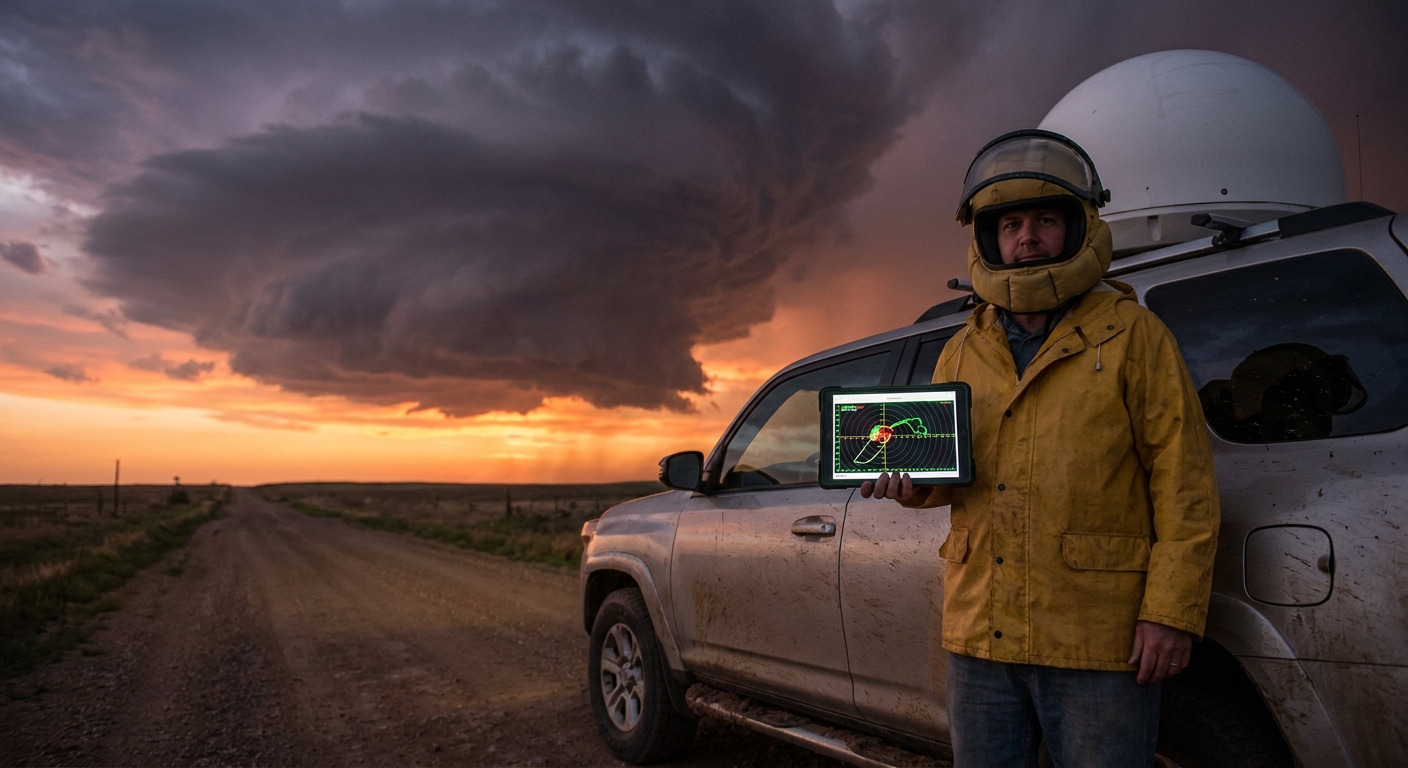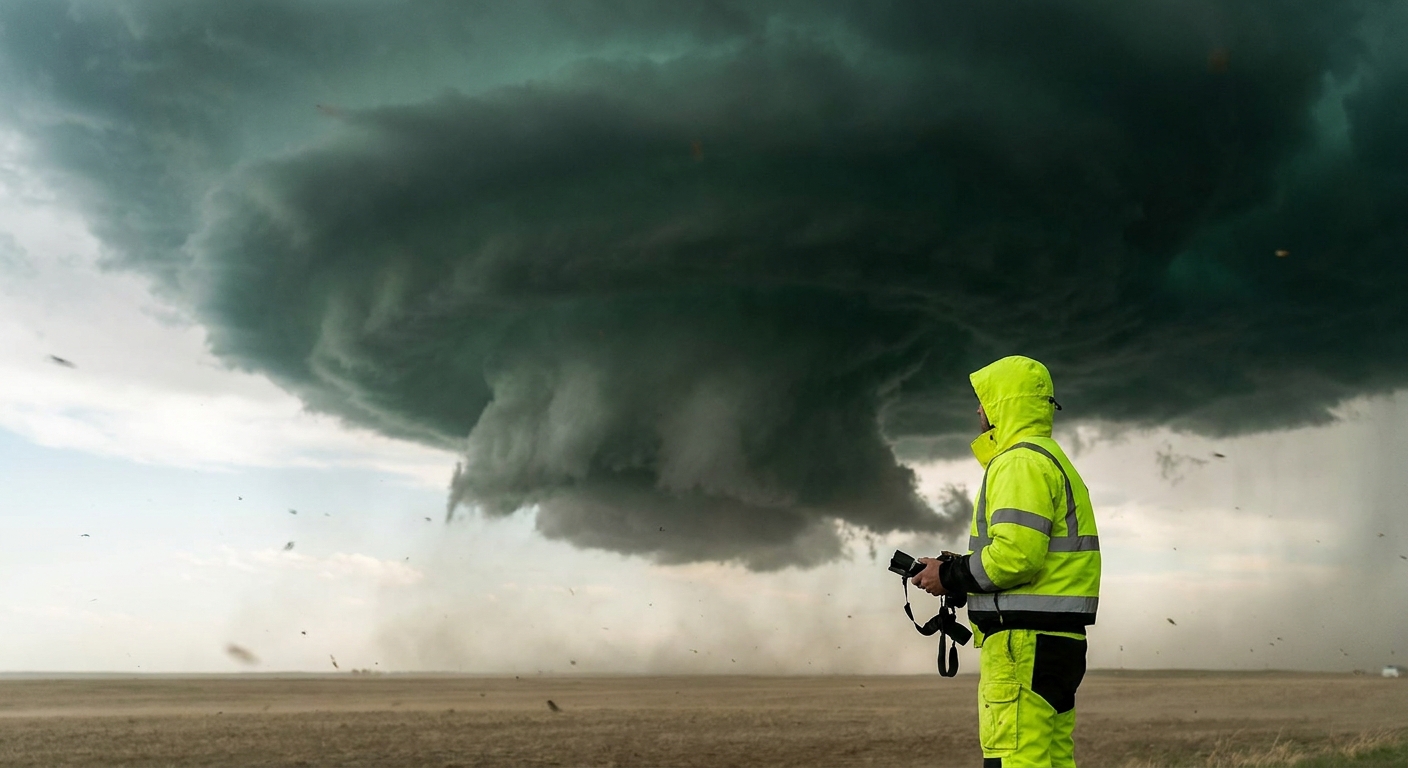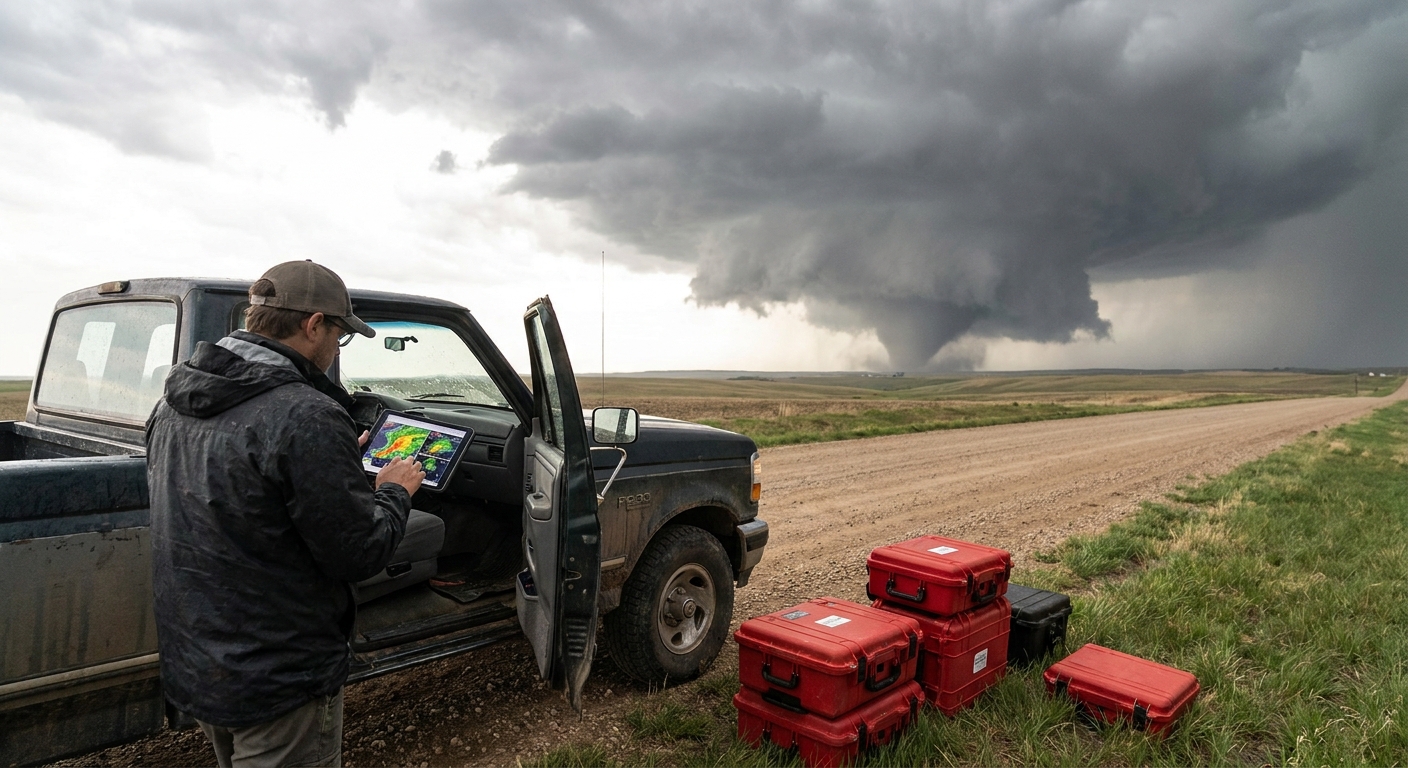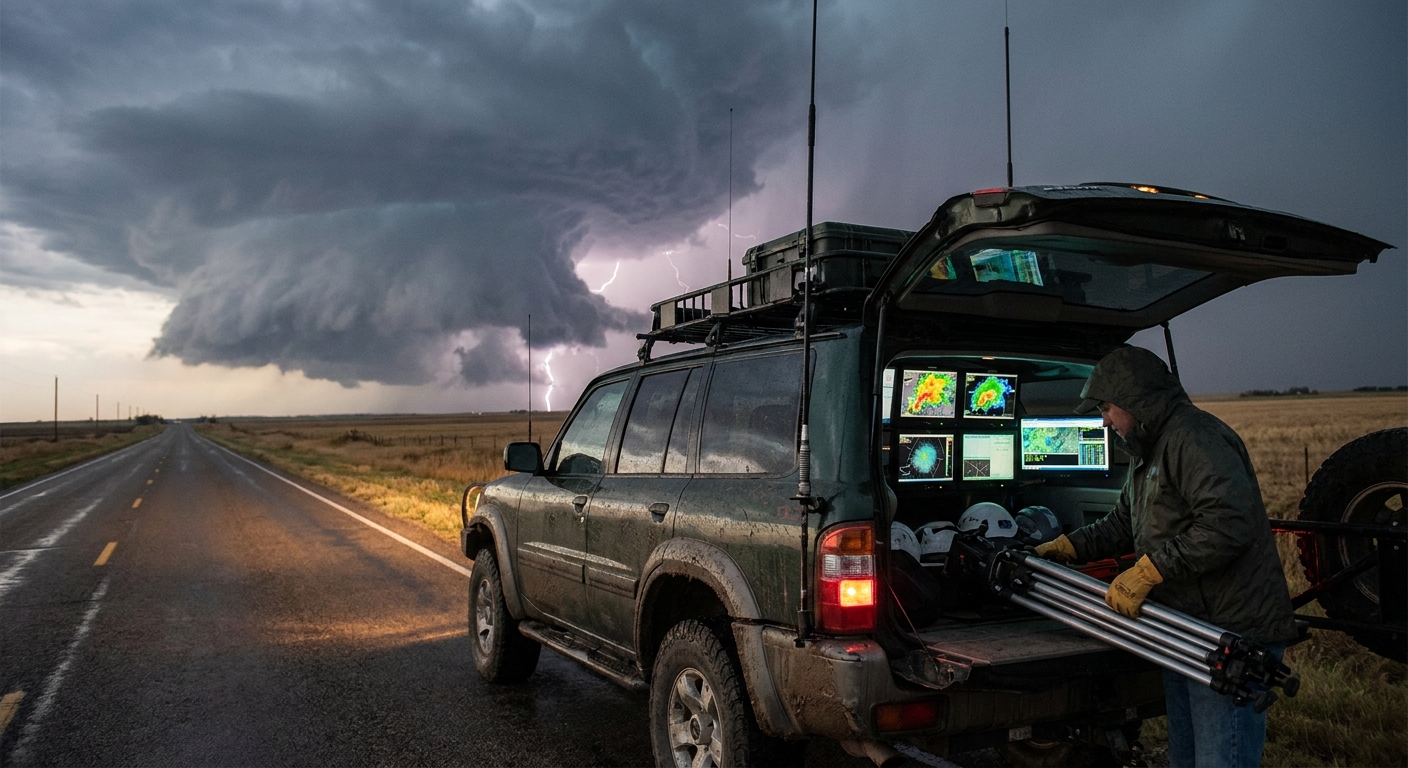
Every season, new chasers roll out with shiny trucks, lifted SUVs, and roof racks loaded with wishful thinking. But when the inflow notch tightens, the RFD wraps around, and the meso passes within a mile of your position, it’s not the vehicle that saves you—it’s the gear you staged before initiation.
Why Your Gear Rig Matters More Than Your Vehicle
Weather gear is your mobile command center. It is the difference between:
- Seeing the hook echo tighten 15 minutes early, or.
- Blindly driving into a rain-wrapped circulation.
I’ve sat on Kansas dirt roads watching a supercell cycle, laptop glowing with dual-polarization data, anemometer screaming over 60 mph, and lightning striking less than a mile away. What kept me there—safely—was not bravado. It was a deliberate, field-tested gear strategy.
This is the full breakdown of a serious chase rig: hardware, software, science, and survival.
Core Meteorological Hardware: Your Mobile Weather Station
1. Radar-Capable Laptop or Tablet (Your Brain)
Smartphone radar is not enough once you’re working tight angles near the mesocyclone.
What you need:
- A rugged laptop or tablet (e.g., semi‑rugged Windows machine) with:
- At least 8 GB RAM
- Good daylight-readable screen
- Long battery life
- A stable mounting system that doesn’t become a projectile in a crash.
Why it matters:
- You can run advanced radar platforms (Gibson Ridge, RadarScope Pro, PYKL3 legacy) with high-res velocity, dual-pol, and tilt switching.
- You can watch storm-scale evolution—tightening velocity couplets, descending reflectivity cores, BWERs—rather than only broad reflectivity sweeps.
2. GPS + In‑Dash Navigation
A GPS puck or integrated GPS is non-negotiable.
Use cases in the field:
- Plotting your exact position against real-time Level II radar.
- Avoiding dead-end roads when a storm reorganizes faster than forecast.
- Coordinating with other chasers via spotter networks (Location sharing is information, not ego).
3. Anemometer & Pressure Sensor
A simple handheld or vehicle-mounted anemometer plus barometric sensor can turn your chase logs into real data.
Meteorological value:
- Pressure falls can hint at deepening mesocyclones or approaching RFD surges.
- Wind shifts and gust fronts confirm outflow boundaries vs. inflow dominance.
- You can document rear-flank downdraft (RFD) arrival and cold-pool intensity.
4. Dash Cameras & Exterior Action Cams
These are not just for highlights on social media.
Critical roles:
- Documenting tornado structure in low visibility for later analysis.
- Capturing damage onset and debris signatures in real time.
- Recording your own driving decisions for post-chase safety review.
Use front and rear dash cams plus at least one roof or window-mounted cam with a wide field of view.
Connectivity: Your Lifeline to the Radar Feed
The best radar app is worthless with no data in the notch.
1. Multi-Carrier Data Strategy
The atmosphere doesn’t care about your cell contract. You need redundancy.
Recommended setup:
- Primary smartphone hotspot (Carrier A)
- Secondary hotspot (Carrier B) or a data SIM in your tablet
- External LTE/5G antenna or booster for fringe coverage
2. Offline Data Safety Net
Storm motions can outrun your data coverage.
Prepare:
- Pre-download hi-res model data (HRRR, NAM 3k) for target area.
- Cache base maps for navigation apps.
- Save morning soundings and skew‑T plots for reference (CAPE, shear, LCLs, hodographs).
When data dies near the vault, your earlier prep becomes your only voice of reason.
Personal Safety Gear: When the Storm Closes In
1. PPE: Helmets, Glass Protection, and Clothing
You will eventually misjudge hail. Everyone does.
Minimum kit:
- Climbing or cycling helmets for all occupants.
- ANSI-rated safety glasses (wraparound) in case of flying glass.
- Heavy-duty rain jacket and waterproof boots.
- Leather or cut-resistant gloves for post-storm debris.
Hail cores punching 2–3 inch stones can blast through side windows. Eye protection turns a terrifying event into a survivable one.
2. First Aid & Trauma Readiness
When you’re closest to the damage path, you may be first on scene.
Pack:
- Comprehensive first-aid kit with:
- Tourniquet
- Trauma dressings
- Israeli bandages
- Nitrile gloves
- Emergency blankets (for shock victims)
- A simple laminated card with basic trauma protocol.
Remember: Lightning, debris, and rollovers are statistically more dangerous to you than the tornado itself.
Visual & Observational Gear: Reading the Sky, Not Just the Screen
1. Binoculars and Spotting Scopes
Storm structure reveals secrets that radar hasn’t resolved yet.
Use optics to spot:
- Rotating wall clouds in the distance when radar still looks broad.
- RFD cut wrapping around the meso.
- Multiple-vortex structure inside large low-contrast tornadoes.
2. Low-Light and Night-Chase Tools
Night chasing is inherently high risk. If you do it, treat gear as life support.
Critical tools:
- High-lumen, wide-beam flashlight.
- Long-exposure-capable camera to pick up structure illuminated by lightning.
- Radar with rapid-scan capability and velocity products front-and-center.
And a hard rule: If you cannot see the base, you chase by radar and conservative positioning only—or you abandon the play.
Radar Analysis Workflow: Gear + Method
All this gear is useless without a disciplined radar workflow. On big days, I run a loop every 2–3 minutes:
Large-Scale Scan (Base Reflectivity):
- Identify dominant storms, boundaries, and mergers. - Check storm-mode: discrete, broken line, QLCS.
Zoom to Target Cell:
- Examine mid-level reflectivity for classic supercell structure (hook, inflow notch, BWER).
Velocity & Dual-Pol:
- Look for tightening couplets, gate-to-gate shear. - Check correlation coefficient for debris signatures if a tornado is suspected.
Overlay GPS:
- Confirm your escape routes relative to forward flank and RFD. - Reposition only with a clear west-southwest or south option if the storm right-turns.
Your laptop, GPS, and data rig are not just tools—they are your storm-time brain.
Chase Narrative: When Gear Makes the Difference
I remember dropping south off a paved road in Oklahoma as a cyclic supercell pulled a classic left-to-right turn toward the highway. Radar showed a broad hook but nothing obvious yet.
Then the data updated.
On the laptop, velocity tightened into a violent couplet in one scan. Dual-pol correlation coefficient plunged. A debris ball flashed into existence.
Outside, visibility was murk: green-tinted core, screaming inflow, horizontal sheets of rain. The only visual clue was a darker smear under the base.
Because the GPS was pinned to radar, I knew the circulation would cross the road less than a mile ahead if I continued east. We bailed south at the next intersection without debate.
Two minutes later, emergency radio crackled to life: confirmed tornado on the highway at exactly the spot we had considered punching.
Gear didn’t make the day exciting. The atmosphere did that. Gear made sure we saw it—and came back to tell the story.
Final Loadout Checklist for Serious Chasers
Use this as a pre-season or pre-chase build guide:
- [ ] Rugged laptop/tablet with advanced radar software
- [ ] GPS with live position overlay on radar
- [ ] Dual-carrier mobile data + external antenna/booster
- [ ] Anemometer & barometric pressure sensor
- [ ] Dash cams (front/rear) + exterior action cam
- [ ] Helmets & safety glasses for all occupants
- [ ] Weatherproof clothing, boots, and gloves
- [ ] Comprehensive trauma-capable first aid kit
- [ ] High-lumen flashlights & backup batteries
- [ ] Binoculars / spotting scope
- [ ] Printed maps for data-dead zones
The storms will come—triple-point setups, dryline magic, classic Plains supercells bending across the horizon. What you choose to carry into that environment decides whether you’re a spectator, a scientist, or a statistic.
Build your rig like your life depends on it—because someday, it might.